

Best Shoes for Standing All Day: What Actually Works for Women
If you're on your feet for six, eight or ten hours, the shoe stops being a style decision and becomes an equipment decision. Standing all day is harder on the body than walking all day — there's no movement to circulate blood, and the same small area of the foot carries the load the entire time.
Here's what actually matters, and what to ignore.
What Standing All Day Does to Your Feet
Static standing compresses the same tissue continuously. Without a supportive base, most women feel it first in the arch and heel, then in the knees and lower back by evening. Swelling through the day is normal — which is why a shoe that fits perfectly at 8am can feel tight by 4pm.
The Four Features That Matter
1. Arch support, not just cushioning
Soft cushioning alone lets the foot collapse inward over hours. You want a contoured footbed that holds the arch, with cushioning on top of it. This is the single biggest difference between a shoe that works for standing and one that doesn't.
2. A firm heel counter
Press the back of the shoe. If it collapses under your thumb, the heel isn't being held and your foot will slide with every shift of weight. It should resist.
3. A slight heel drop
Completely flat is not the same as comfortable. A small lift — roughly half an inch to an inch — relieves tension through the calf and Achilles. A low wedge is genuinely easier for standing than a flat.
4. A wide enough toe box
Toes need to spread to stabilise you. Any pressure across the widest part of the foot compounds over hours.
Best Shoe Types for Long Days on Your Feet
Supportive closed-toe flats
The most versatile option: coverage, structure and a cushioned footbed. Browse comfortable walking shoes for styles built to stay on all day.
Orthopedic-style sandals
For warm months, a contoured sandal with a moulded footbed and adjustable straps beats a flat sandal by a wide margin. The straps matter as much as the footbed — they stop the foot sliding forward.
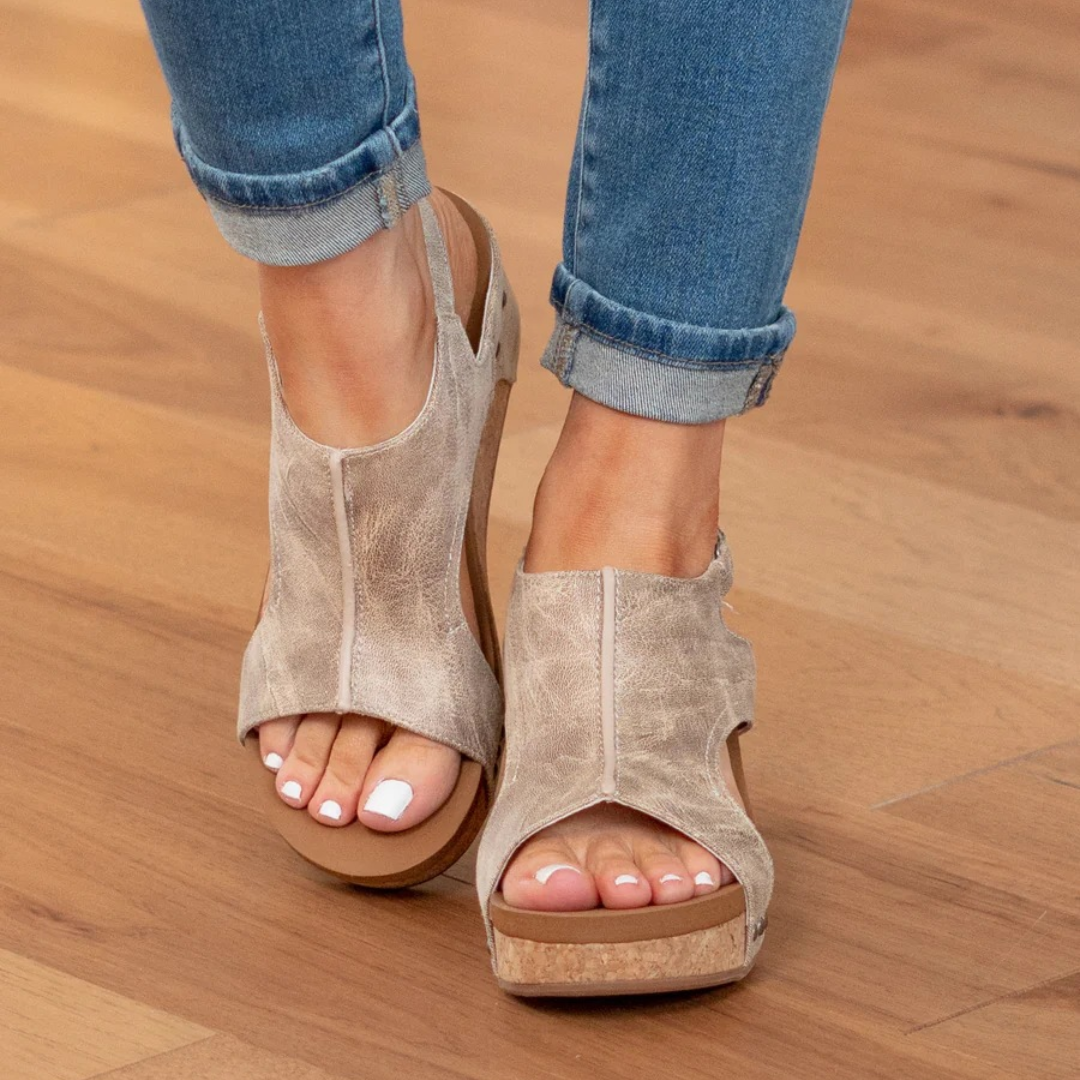
Low wedges
A wedge distributes weight across the whole sole rather than concentrating it under the heel. For occasions where a flat feels too casual, this is the comfortable answer.
What to Avoid
- Thin flat soles. Ballet flats and unstructured slides offer almost nothing over long periods.
- Backless styles. Without a heel strap, your toes grip to keep the shoe on — for hours.
- Anything you had to "break in." A shoe that hurts new will hurt on hour eight.
Two Habits That Help as Much as the Shoe
Rotate pairs. Alternating two pairs across the week changes the pressure points and lets cushioning recover its shape.
Buy in the afternoon. Feet swell through the day. A shoe fitted in the morning will be the wrong size when you need it most.
Frequently Asked Questions
Are flat shoes bad for standing all day?
Completely flat, unstructured shoes are. A flat with a contoured footbed and a small heel drop is fine — it's the lack of support, not the lack of height, that causes problems.
Are sandals suitable for standing all day?
Yes, if they have a moulded footbed and adjustable straps. Flat slides and flip-flops are not.
What heel height is best for standing?
Between half an inch and one and a half inches, on a wedge or block — enough to unload the calf without shifting weight onto the forefoot.
How often should I replace shoes I stand in?
When the footbed no longer springs back or the tread wears unevenly. Under daily all-day use, that's often within six to nine months.
Shop Supportive Styles
See walking shoes and supportive sandals, or read our full guide to comfortable walking shoes for women.
Leave a comment
This site is protected by hCaptcha and the hCaptcha Privacy Policy and Terms of Service apply.